What if the greatest barrier to your inner peace isn't actually a busy mind, but the physical reality of sitting still? For many, the traditional meditation cushion feels less like a sanctuary and more like a test of endurance. You're told to breathe through the chaos, yet your lower back aches and your thoughts continue to race like a motor that won't shut off. It's a common struggle to feel like you're failing at relaxation when your body simply refuses to cooperate with the silence.
When comparing float therapy vs meditation, it's important to understand that while both aim for the same destination of stillness, they take very different routes. You deserve a reliable way to lower stress and reset your nervous system without the uphill battle of physical discomfort. In this article, you'll discover how floatation therapy offers a unique shortcut to the flow state by removing the external world entirely. We will examine which path provides the fastest results for deep mental clarity and immediate relief from the heavy weight of chronic stress, helping you choose the practice that fits your journey toward renewal.
Key Takeaways
- Understand how both practices work to reset your nervous system and lower cortisol levels for long-term stress management.
- Explore the core differences in float therapy vs meditation to decide if you need the active skill-building of a cushion or the passive, effortless relief of a tank.
- Learn how to bypass common meditation obstacles like physical discomfort and the "monkey mind" through the unique power of weightlessness.
- Determine which path offers the fastest results for your specific needs, from immediate physical recovery to long-term cognitive control.
- Discover the "synergy effect" and how regular floating can actually accelerate your progress and mastery in a traditional meditation practice.
The Biological Goal: How Both Practices Reset Your Nervous System
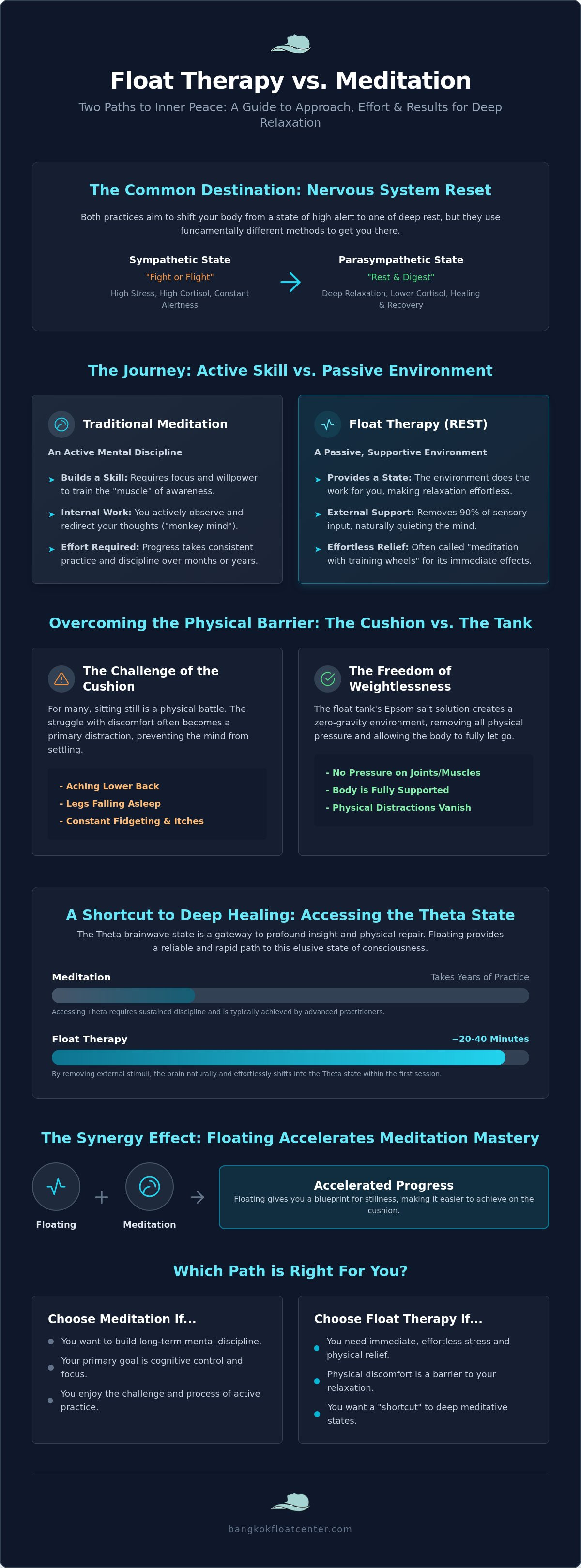
Modern life often feels like a relentless stream of sensory input. From the blue light of our screens to the constant hum of city traffic, our brains are rarely given a moment to fully downshift. This persistent stimulation keeps us locked in the sympathetic nervous system, better known as the "fight or flight" response. While this state was once vital for survival, staying in it for too long leads to exhaustion and burnout. To find true renewal, we must find a way to trigger the parasympathetic nervous system, the body's natural "rest and digest" state.
Both float therapy and meditation serve as powerful tools to facilitate this biological transition. While they use different methods, their shared goal is to quiet the internal alarm system. When evaluating float therapy vs meditation, it's helpful to see them as two different paths leading to the same sanctuary of stillness. One relies on internal focus, while the other utilizes a specialized environment to gently encourage the brain to let go of its defensive posture.
The Science of Cortisol and Stress Recovery
Chronic stress creates a chemical burden on the body by keeping cortisol levels pathologically high. Cortisol is the body's primary stress hormone; when it remains elevated, it disrupts sleep, impairs immune function, and clouds mental clarity. Meditation addresses this by training the mind to observe stressors without becoming entangled in them, eventually lowering the chemical output of the adrenal glands. Floating approaches the problem from the outside in. By utilizing Restricted Environmental Stimulation Therapy (REST), the body is relieved of the need to process external data, which naturally signals the nervous system to stop producing stress hormones. The relaxation response is the physiological opposite of the stress response.
Theta Brainwaves: The Gateway to Deep Healing
As you begin to relax, your brainwaves undergo a fascinating transformation. You move from the alert, often anxious Beta state into the calm, creative Alpha state. However, the deepest healing occurs in the Theta state. This is a dreamlike frequency where the body begins to repair itself and the mind experiences profound insights. Traditional meditators often spend years practicing before they can reliably access Theta states during a session. Floating provides a unique shortcut. Because the tank eliminates light, sound, and the sensation of gravity, most people find their brain naturally "forces" a shift into Theta within just 20 to 40 minutes of entering the water. It's an effortless descent into a level of stillness that usually takes a lifetime of discipline to achieve.
Active Skill vs. Passive Environment: The Effort Gap
The primary hurdle for most seekers of stillness is the sheer amount of effort required to reach it. When we look at float therapy vs meditation, the most striking difference lies in the level of active participation. Meditation is often described as a "mental gym," a place where you go to build the muscles of focus and awareness. While this is incredibly rewarding over time, it requires a significant amount of willpower to sit through the noise of your own mind and the distractions of the physical world.
Meditation as an Active Mental Discipline
In a traditional mindfulness practice, the goal isn't to stop your thoughts, but to notice them without attachment. You're constantly redirecting your attention back to your breath, a mantra, or a physical sensation. This discipline is a skill that takes months or even years to refine. Many people find themselves frustrated by the "monkey mind," that restless part of the brain that leaps from one worry to the next. In a noisy room or a body that feels stiff, this frustration often leads people to quit, convinced they're simply "not good" at relaxing. The struggle to remain present while your legs fall asleep or your back aches can make the path to stillness feel like a grueling chore rather than a relief.
The Passive Power of Sensory Deprivation
Floating flips this dynamic on its head. Instead of you doing the work, the environment does the work for you. By removing 90% of sensory input, the float tank acts like "meditation with training wheels." You don't have to fight to ignore the sound of the heater or the itch on your leg because the environment has already neutralized those signals. This shift is supported by a clinical trial on floatation-REST, which highlights how this specific environment can significantly reduce the symptoms of anxiety by allowing the nervous system to downshift without the usual effort.
This is why many wellness experts call floating "meditation on steroids." Even if your mind continues to chatter, your body is still receiving a profound physiological reset. You aren't required to "do" anything. The water supports you, the darkness holds you, and the silence invites your brain to enter those deep Theta states that usually require years of monastic practice to access. While a traditional meditator might spend forty minutes just trying to settle their breath, a floater often reaches that same level of neurological depth in half the time because the external obstacles have been removed. If you've struggled to find your center on a cushion, you might find that experiencing a session in a float pod provides the shortcut your nervous system has been craving. It's not about working harder to be still; it's about letting the environment carry you there.
Weightlessness vs. The Cushion: The Physical Factor
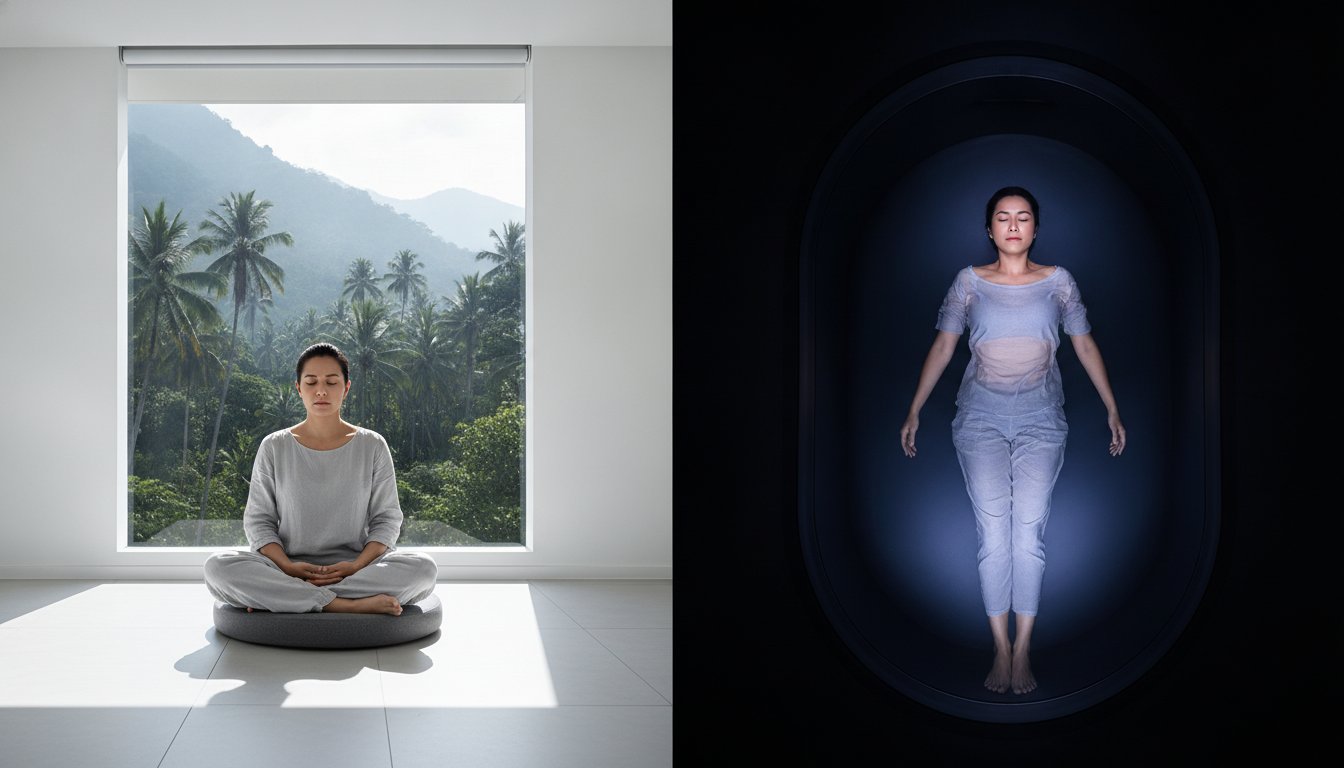
Imagine trying to find a state of total tranquility while your lower back sends sharp signals of protest and your left foot begins to tingle with numbness. This is the physical reality many face when sitting on a meditation cushion. In the debate of float therapy vs meditation, the physical environment is often the deciding factor for those who find traditional practices more painful than peaceful. While meditation asks you to transcend the body, floating allows you to simply leave it behind for a while.
Overcoming the Physical Barrier to Stillness
Pain acts as a biological tether. When your brain receives signals of discomfort, it prioritizes those messages over your attempts at mindfulness. It's a survival mechanism; you can't easily enter "the zone" when your body feels under stress. This is where zero gravity therapy Bangkok transforms the experience. By floating in a solution maintained at a specific gravity of 1.23 to 1.3, every muscle, joint, and vertebrae is released from the constant pressure of gravity. Your spine decompressess naturally, and the chronic tension you carry in your neck and shoulders simply dissolves into the warm water.
The transition from a heavy, earthbound body to a state of weightlessness provides a level of physical relief that no cushion can replicate. It removes the "body noise" that often prevents beginners from reaching deeper states of consciousness. You aren't fighting your posture; you're being held by a supportive, liquid embrace that allows your skeletal system to rest completely for the first time in years.
The Magnesium Advantage
Beyond the buoyancy, there is a chemical advantage to the water itself. Each tank is saturated with high-quality Epsom salts, which are rich in magnesium. This essential mineral plays a critical role in regulating the nervous system and easing muscle spasms. As you float, your skin absorbs magnesium transdermally, providing a direct path to physical recovery. While traditional meditation focuses almost entirely on mental discipline, floating offers a dual-track approach. You receive the mental reset of a deep meditative state alongside a physical treatment that reduces inflammation and restores your body's balance. This combination makes it an ideal sanctuary for those whose stress is as much a physical burden as it is a mental one. By the time you step out of the pod, your muscles feel as renewed as your mind, a synergy that sitting in a chair simply cannot provide.
Which Should You Choose? A Goal-Oriented Comparison
Deciding between float therapy vs meditation isn't about finding which practice is objectively better. Instead, it's about identifying which tool matches your current mental and physical state. Think of meditation as your "daily maintenance." It's a consistent, low-cost habit that builds long-term cognitive control and emotional resilience. Floating, by contrast, acts as the "emergency brake." When the noise of life becomes deafening and your stress levels feel insurmountable, the tank provides an immediate, deep reset that a 10 minute breathing exercise simply can't reach.
Assessing your current stress level is the first step in choosing your path. If you feel generally balanced but want to sharpen your focus, meditation is an excellent foundation. However, if you're standing on the edge of burnout, your nervous system may be too agitated to sit still. In those moments, the passive environment of a float pod offers the sanctuary you need to begin the recovery process without the pressure of "performing" relaxation.
When Meditation is the Right Tool
Meditation excels as a portable skill for the real world. Because it requires no equipment, it's the perfect method for building resilience before a high-pressure meeting or taking a micro-break during a busy afternoon. It trains you to remain centered amidst the chaos of daily life. By practicing mindfulness on a regular basis, you develop the ability to observe your reactions in real-time, allowing you to choose composure over conflict. It's a sustainable, lifelong discipline that strengthens your mind's ability to navigate the world with grace and intentionality.
When Floating is the Superior Choice
There are times when the "monkey mind" is too loud to ignore and your body is too tense to rest. Floating is the superior choice when you're recovering from extreme sensory overload or a grueling physical week. It's also a powerful tool for breaking through creative blocks. By removing the constant stream of external data, your brain is free to make new connections and solve complex problems in a way that isn't possible in a distracting environment.
Floating addresses the heavy, physical tension that meditation often leaves behind. If you find that your stress has manifested as tight shoulders or a restless spirit, the weightless environment provides the relief you've been searching for. It's a bold invitation to experience total stillness without the struggle. If you're ready to experience a level of peace that goes beyond the cushion, you can book your first float session to see how quickly your nervous system can truly let go. Whether you need a weekly reset or a one-time escape from the weight of the world, choosing the right method for your specific goal ensures your journey to stillness is both effective and restorative.
The Synergy: How Floating Accelerates Your Meditation Mastery
While the debate of float therapy vs meditation often frames them as competing paths, the most effective wellness routine integrates both. Think of the float tank as a high-tech laboratory where you can "memorize" the feeling of deep stillness. When you return to your daily ten minute meditation on a cushion, your brain now has a physiological reference point for what true peace feels like. It's much easier to find your center when you've already experienced it in its purest, most absolute form. This synergy creates a reliable bridge between the sanctuary of the tank and the demands of your daily life.
The tank provides a unique form of biofeedback without the need for wires or electronics. In the absolute quiet, you'll notice even the smallest flicker of a distracting thought or a subtle muscle twitch. This heightened awareness is a gift for any meditator. It shows you exactly where your mind tends to wander, allowing you to sharpen your focus in a way that's difficult to achieve in a world full of background noise. By using the pod to reach the depths of stillness, you're essentially training your nervous system to recognize and return to that state more quickly during your daily practice.
The Float-to-Meditation Protocol
To maximize the benefits of your practice, try using the first ten minutes of a 90 minute float session Bangkok for active breathwork. Instead of waiting to drift off, use the silence to anchor your focus and settle your mind. This intentional start deepens the session and extends the "afterglow" effect long after you leave the water. Many practitioners find that meditating the morning after a float feels significantly more effortless, as the body remains in a restorative state. Regular sessions in a float pod Bangkok act as a monthly "deep clean" for the mind, clearing out the accumulated sensory clutter that often makes a daily meditation habit feel like an uphill battle.
Your First Step Toward Total Stillness
If you're a beginner, starting with a professional session allows you to bypass the steep learning curve of traditional mindfulness. You don't have to spend years mastering your focus before you can feel the benefits of a quiet mind. When choosing a facility, look for a professional sensory deprivation tank Bangkok that adheres to the latest industry benchmarks. According to the 2025 North American Float Tank Standards, the solution must be maintained at a specific gravity of 1.23 to 1.3 and a skin-neutral temperature between 92-96°F (33.3-35.6°C). These precise conditions ensure you achieve the total weightlessness necessary for a deep mental reset. We invite you to step away from the noise and experience the contrast for yourself, finding a path to stillness that is as gentle as it is profound.
Step Into Your Sanctuary of Stillness
Finding your path to peace doesn't have to be a struggle against your own mind or body. Whether you choose the portable discipline of a daily practice or the profound, weightless reset of a pod, the goal remains the same: a balanced nervous system and a quieted spirit. When evaluating float therapy vs meditation, remember that you don't have to choose just one. You can use the effortless environment of the tank to deepen your mastery of stillness and carry that clarity back into your world.
Ready to leave the noise behind? Book your escape to stillness at Bangkok Float Center and experience our professional zero-gravity pods. Our private suites feature restorative rainfall showers and expert guidance to ensure first-time floaters feel completely at ease. Your journey toward renewal is a personal one; we're here to help you find the serenity you deserve.
Frequently Asked Questions
Is floating better than meditation for anxiety?
Floating offers a faster physiological reset for acute anxiety by instantly removing external triggers. While meditation is a vital skill for long-term resilience, it can be difficult to practice when your mind is already racing. When comparing float therapy vs meditation, the tank provides an immediate sanctuary where your nervous system can downshift without the effort of trying to "quiet" your thoughts manually.
Can I meditate while I am inside the float tank?
Yes, you can certainly practice your favorite meditation techniques while you float. Many guests find that the first few minutes of a session are perfect for breathwork or body scans. Because the environment removes physical distractions and the weight of gravity, your meditative focus often becomes much deeper and more effortless than it ever could be on a traditional cushion.
How often should I float to see results compared to meditation?
You'll feel the mental and physical results of a single float session immediately, whereas meditation usually requires daily practice over several weeks to notice a shift. For the best balance, many people find that a weekly or bi-weekly float provides a profound mental "deep clean." This restorative reset then makes your daily five or ten minute meditation habit much easier to maintain.
I can’t sit still for 5 minutes, will I be able to float for 60?
You will likely find floating much easier than sitting in a chair because the water removes the physical discomfort that causes restlessness. In the tank, you are weightless and your joints are completely supported. Without the "body noise" of backaches or numb legs, sixty minutes often passes much faster than five minutes spent struggling to stay upright on a meditation stool.
Does floating replace the need for a daily meditation practice?
Floating serves as a restorative supplement rather than a total replacement for a daily meditation practice. Meditation is a portable skill you can use in a stressful meeting or on a busy train. Floating is a specialized environment for deep recovery. Using both together allows you to build mental strength daily while receiving a significant nervous system reset during your scheduled sessions.
What if I fall asleep while floating instead of meditating?
Falling asleep is entirely safe and is often a sign that your body is entering a state of much-needed repair. The high concentration of Epsom salts keeps you buoyant and face-up regardless of whether you're awake. Many people find that a "float nap" is incredibly restorative, providing a level of refreshment that feels like several hours of deep, uninterrupted sleep in a bed.
Is floating safe for people who feel claustrophobic during meditation?
Floating is safe and gives you full control over your environment at all times. Unlike the internal "trapped" feeling some experience during silent meditation, you can choose to leave the pod light on or keep the lid open if you prefer. Most guests find that once they feel the weightlessness, the sensation of the tank walls disappears into a feeling of vast, open space.
Why is floating more expensive than meditation?
The price of a session reflects the specialized technology and pristine environment required to achieve total stillness. While meditation only requires a quiet corner, a float session involves a sophisticated pod, hundreds of kilograms of high-grade Epsom salts, and complex filtration systems. You're paying for a curated sanctuary that removes every external obstacle to relaxation, allowing you to reach deep states of peace instantly.